Managing cash flow is the perpetual challenge for small business owners. When expenses are due but client payments are 30, 60, or 90 days out, businesses need quick, reliable access to working capital. Two popular and distinct solutions are invoice factoring and a business line of credit. Understanding the core difference between these methods—one is selling an asset, the other is borrowing money—is crucial for choosing the right tool to stabilize and accelerate your small business cash flow.
Invoice Factoring: Selling an Asset
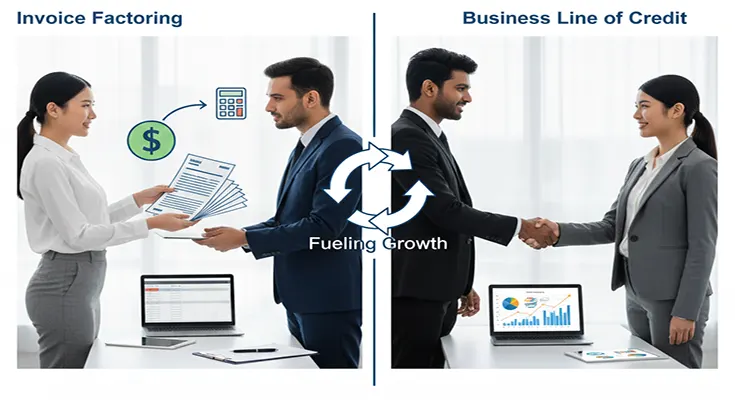
Invoice factoring (or accounts receivable financing) is the sale of your outstanding customer invoices to a third-party financier (the factor) at a discount.
- How it Works: You generate an invoice, sell it to the factor for typically 80% to 90% of its value upfront, and receive the rest (minus fees) once the customer pays the factor.
- Best For: Companies with reliable, creditworthy B2B or B2G clients who need immediate cash against existing sales. It is particularly useful for new businesses that lack collateral or a long credit history.
- The Cost: Fees are charged as a percentage of the invoice value, usually calculated weekly or monthly until the invoice is paid. This cost can sometimes be higher than a traditional loan’s interest rate.
- Impact on Balance Sheet: Factoring is treated as the sale of an asset, not a loan. It does not add debt to the balance sheet.
- The Client Experience: In non-recourse factoring, the factor often takes over collections. Your client may know a third party is handling the invoice.
Business Line of Credit (LOC): Revolving Debt
A business line of credit is a flexible loan product that allows a business to borrow up to a certain limit, pay it back, and borrow again—similar to a credit card, but with much lower interest rates and higher limits.
- How it Works: Once approved, you draw funds as needed, and you only pay interest on the amount you actually use.
- Best For: Businesses with predictable revenue that need funds for short-term operating expenses, unexpected opportunities, or seasonal inventory purchases.
- The Cost: Interest accrues daily only on the drawn amount. Fees may include an annual maintenance fee or draw fees.
- Impact on Balance Sheet: An LOC is a debt obligation and appears as a liability.
- The Client Experience: The business remains solely responsible for collections and customer interaction; the client is unaware of the financing arrangement.
Choosing the Right Tool for Your Cash Flow
| Feature | Invoice Factoring | Business Line of Credit (LOC) |
| Source of Capital | Accounts Receivable (Sales) | Lender’s Capital (Debt) |
| Credit Focus | Client’s Creditworthiness | Your Business and Owner’s Creditworthiness |
| Speed | Very Fast (Often 24–48 hours) | Moderately Fast (Days to Weeks) |
| Flexibility | Tied directly to the value of your invoices. | Highly Flexible (Draws as needed up to a limit). |
The decision hinges on two things: your business’s financial profile and the nature of your need. If your company is young or credit-challenged but has strong, paying clients, invoice factoring is a fast route to unlock capital trapped in outstanding invoices. If your business is established and needs flexibility for general operational needs, a business line of credit provides a cheaper, discreet, and revolving source of working capital.